#include "config.h"#include "ncp_session.h"#include <algorithm>#include <cassert>#include <cstring>#include <iostream>#include <plpintl.h>#include <pthread.h>#include "ncp_log.h"#include "socketchannel.h"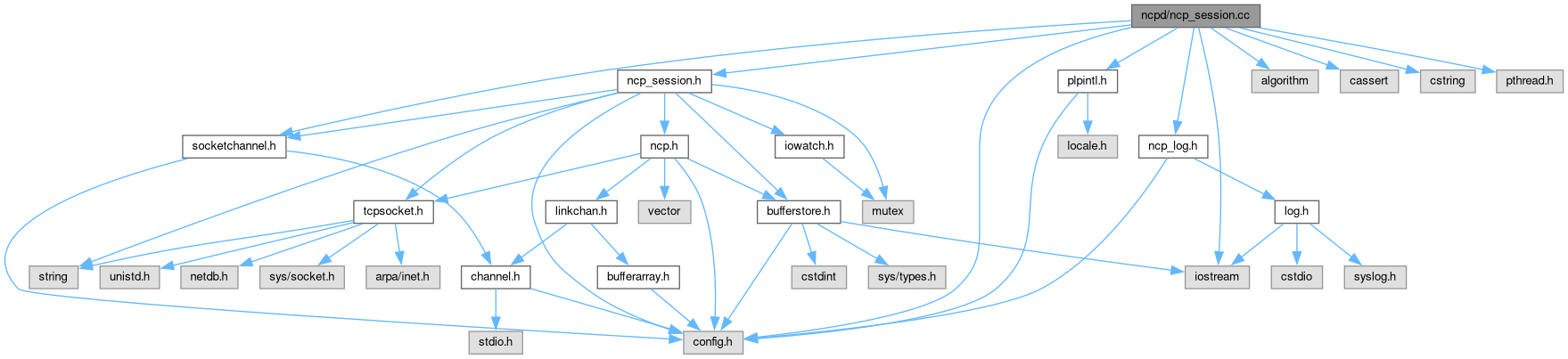
Go to the source code of this file.
Functions | |
| void * | link_thread (void *arg) |
| void * | socket_connection_polling_thread (void *arg) |
| Responsible for driving the SocketChannel instances (incoming TCP connections) by means of SocketChannel::socketPoll. More... | |
| void | check_for_new_socket_connection (NCPSession *session) |
| void * | ncp_session_main_thread (void *arg) |
Function Documentation
◆ check_for_new_socket_connection()
| void check_for_new_socket_connection | ( | NCPSession * | session | ) |
Definition at line 123 of file ncp_session.cc.
◆ link_thread()
| void * link_thread | ( | void * | arg | ) |
- Todo:
- There's something really nuanced going on with the use of the NCPSession::socketChannelWatch_ here. Specifically, while it might look like it's just being used as a timeout (which might be the intent), new TCP sockets are added to it on a successful accept, meaning that this will wake up frequently whenever there's activity on the socket. This will cause frequent NCP::hasFailed checks, and very timely resets (NCP::reset) whenever a client is connected. It's possible this was introduced as a work-around to connectivity issues. It is also worth noting that IOWatch is not thread-safe, so using it in link_thread, and adding to it in ncp_session_main_thread (as we are doing) is definitely a bad thing.
The NCP::reset call here is currently required (even though it feels like it shouldn't be) as it's responsible for preparing the stack after a successful connection has ended (packet currently has responsibility for performing internal resets when auto-detecting baud rate).
Definition at line 51 of file ncp_session.cc.
◆ ncp_session_main_thread()
| void * ncp_session_main_thread | ( | void * | arg | ) |
Definition at line 171 of file ncp_session.cc.
◆ socket_connection_polling_thread()
| void * socket_connection_polling_thread | ( | void * | arg | ) |
Responsible for driving the SocketChannel instances (incoming TCP connections) by means of SocketChannel::socketPoll.
This isn't likely to scale particularly well as it polls all connected sockets whenever a single one wakes up, but it seems to work (as we never have that many connected clients).
Definition at line 78 of file ncp_session.cc.